

Observers: chaperones, protection and guidance
Quick guide
- During some patient examinations, it may be helpful to have an observer to reassure the patient and to protect the doctor.
- Before examining a patient, always explain the nature of the examination and the reason for performing it and obtain consent.
- It is important to document all offers you make for an observer to be present and the patient’s responses. If an observer is present, record their name and title in the medical record.
Why use an observer?
Having an observer (sometimes called a chaperone or practice monitor) present as a witness to an intimate medical examination may benefit both you and the patient. It can be reassuring to a patient who is fearful, vulnerable or embarrassed.
Regardless of your intentions, if a patient perceives that your remarks are inappropriate or that your examination was insensitive or improper, they may complain. Having an observer present may protect you from an allegation of inappropriate or unprofessional conduct.
When to use an observer
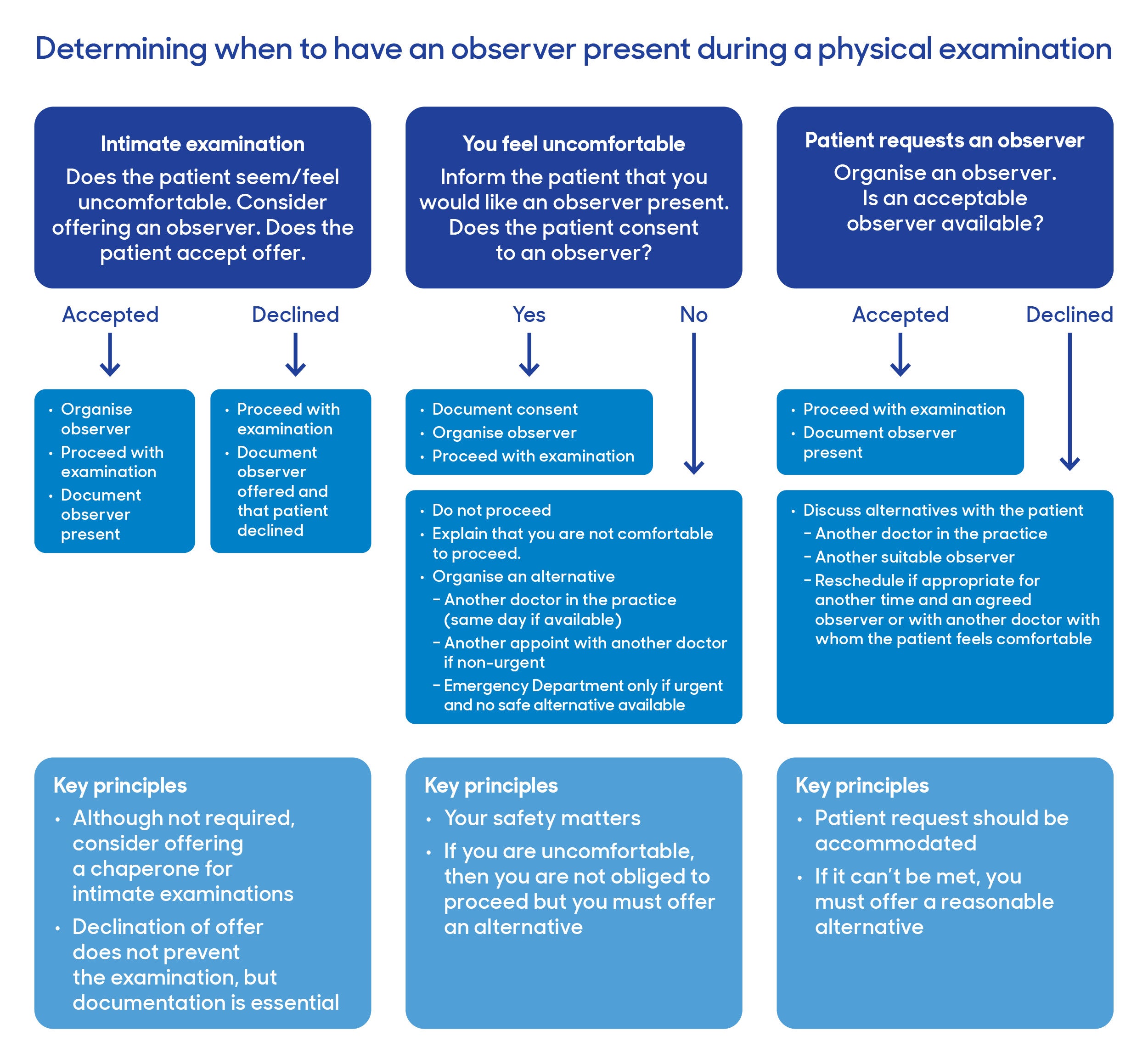
The Medical Board of Australia’s Guidelines: Sexual boundaries in the doctor–patient relationship do not specify when an offer of an observer should (or must) be made. The AMA’s guidance suggests a medical practitioner may wish to have an observer present:
- when requested by the patient
- during an intimate examination
- if a patient appears particularly uncomfortable, reluctant, or distressed
- where the doctor feels uncomfortable
What a patient considers to be an intimate examination may be influenced by their cultural values and beliefs. Be alert to verbal and non-verbal signs of discomfort, and use your professional judgement when deciding whether to offer an observer.
If an observer is offered because the patient appears uncomfortable or you feel uncomfortable proceeding, it may be helpful to explore the patient’s reasons for declining. Some patients may be reassured by an explanation of the observer’s role, including that the observer may remain in the room but not in direct view of the examination.
If the patient continues to decline an observer and you are uncomfortable proceeding, it is appropriate to defer the examination and refer the patient to a colleague where the situation is not urgent. If urgent assessment is required, consider referral to an emergency department.
It is ethically and professionally acceptable to decline to proceed without an observer where you have concerns, provided the patient’s clinical needs are addressed. Carefully document any discussion about the offer of an observer, the patient’s decision, and the follow-up plan.
The practice of medicine relies on trust and confidence between doctor and patient, and appropriate physical examinations are an essential part of that relationship. Once trust has been established, you may decide that routinely offering an observer is unnecessary; however, this should always be assessed on a case-by-case basis.
Circumstances requiring caution
Particular care should be taken when:
- conducting an intimate examination on any patient, regardless of how long they have been your patient
- there are any communication difficulties or language barriers, for example the patient is from a non-English speaking background
- a patient attends for the first time with a problem requiring breast, anal or genital examination
- a patient consults with you after hours and you are alone in the practice
- the patient is a child or young person or there is an impairment which suggests they may not be able to consent to the examination
- a patient uses sexually explicit language, displays inappropriate feelings or exhibits sexualised behaviour
- the patient has a history of sexual assault
- conducting a medico-legal assessment (such as acting as an independent assessor for a WorkCover claim or similar) on a person who is not a patient of the practice.
Medico-legal assessments have a unique set of challenges as the patient may perceive the doctor to be adversarial. We would recommend a low threshold for the presence of an observer in these situations.
When examining young children, it is likely that an appropriate adult will always be present. For adolescents and young adults, you might suggest having an observer present if you think it would help them feel more comfortable. But in some situations, having another person present may make them feel uncomfortable or embarrassed and that might put them off engaging with their care. Sometimes a young person who comes in with a parent or guardian might prefer a nurse to stay instead of their family member. When you talk about this, keep your language clear and supportive. In the end, you’ll need to use your own professional judgment to decide what’s best.
Observer or support person?
An observer should be qualified (a nurse – RN or EN, or other registered health practitioner) or someone appropriately trained (other clinical support staff) so that they fully understand their role. Usually, the examining doctor will be the one to suggest having an observer present. The observer should be a person acceptable to, but often not connected to, the patient. In most cases, they will be a person of the same gender as the patient.
A patient might also ask to have a support person with them, often a friend or family member. In some situations—such as when the patient is a child, a young person, or for cultural reasons—having a support person instead of an independent observer can be the better option. If a support person is present, make sure the patient is genuinely comfortable with it, and take care to protect their privacy and dignity throughout.
The role of a support person is not the same as that of an observer so there may be times when both an observer and a support person are present.
What if an observer is not available?
If a patient asks for an observer and a suitable person is not available, you may offer to reschedule the appointment so an observer can be arranged. Alternatively, you could refer the patient to a colleague if they would feel more comfortable with another doctor (for example, someone of the same gender as the patient or a different gender to you). If the consultation is deferred, let the patient know about any effect the delay may have on their health and document this discussion in their medical records.
Other third parties
Always obtain consent from your patient for any other person to be present in the consultation. This could include, for example, interpreters, a registrar, medical or nursing student or somebody undertaking a review of your practice. This should be done before the consultation, ideally in writing, to give the patient the option to decline. The patient may feel obliged or pressured to agree if asked in the consulting room or in front of the third party.
Documentation
It is important to document in the patient’s medical record that an observer has been offered and whether the patient accepted or refused. If the patient declines, document the reason.
If a patient agrees to have an observer, or a support person or another third-party is present at the patient’s request, ensure you document this in the clinical records.
Document who is present including their name and job title, and/or relationship to the patient.
Additional resources
Avant factsheet: Boundary issues
AMA position statement “Maintaining Clear Sexual Boundaries Between Doctors and Patients and the Conduct of Patient Examinations 2019”
Medical Board of Australia - Sexual boundaries in the doctor-patient relationship
More information
For medico-legal advice, please contact us here, or call 1800 128 268, 24/7 in emergencies.
The information in this publication does not constitute legal, financial, medical or other professional advice and should not be relied upon as such. It is intended only to provide a summary and general overview on matters of interest and it is not intended to be comprehensive. Persons implementing any recommendations contained in this publication must exercise their own independent skill or judgement and seek appropriate professional advice relevant to their own particular circumstances. Compliance with any recommendations will not in any way guarantee discharge of the duty of care owed to patients and others coming into contact with the health professional or practice. Avant and its related entities are not responsible to any person for any loss suffered in connection with the use of this information. Information is only current at the date initially published.