
Single vision
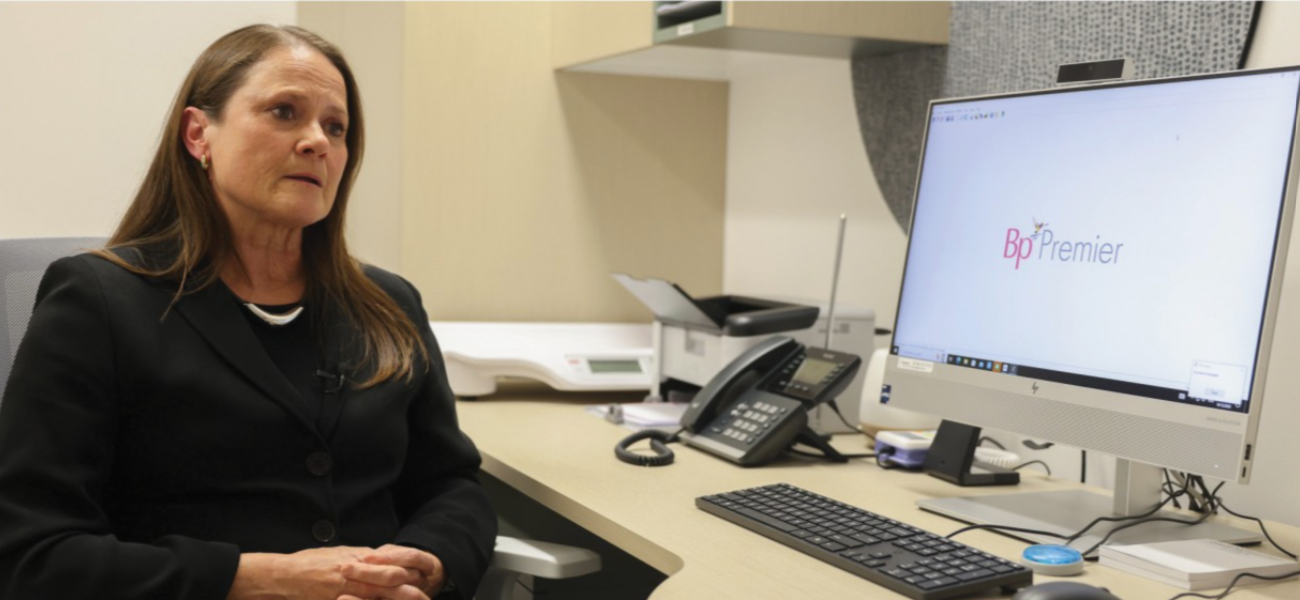
Dr Nerida McDonald
Photography: Supplied
In the final months of 2022, as many small practices across Sydney were still recovering from the disorientation of COVID, Dr Nerida McDonald of Sydney’s Walker Street Doctors stood in a cramped, windowless treatment room she jokingly described as “a Harry Potter cupboard under the stairs”. The practice had nine doctors rotating through four consulting rooms. There was no tea room. The building itself was being sold off. After a decade of making do, the practice had hit a wall.
For Dr McDonald, the dilemma was blunt: fold or take a leap that would reshape the future of Walker Street Doctors. “I either needed to fold or expand,” she says. As the sole owner, there was no partner to share the risk. Taking on a 10-year lease at more than triple the current rent, with a major fitout and no signed pathology sublease at the time, required a level of courage she describes, with characteristic understatement, as “a big risk”.
Yet it also crystallised her belief that small, independent practices could be modern, sustainable and deeply fulfilling workplaces. What followed was the most significant expansion in the practice’s history—and a renewed commitment to a model of general practice built around time, care and genuine clinical relationships.
Pain and possibility
Walker Street Doctors opened in 2012, as a modest three-room practice on the sixth floor of a North Sydney office tower. At the time, Dr McDonald had already spent 15 years as one of four owners in a group practice. Those years taught her a great deal about patient care and teamwork—but they also revealed a culture of inertia she found increasingly difficult to work within.
She knew general practice could be better: structured appointments that run to time, less stressed doctors, and a financial model that supports rather than punishes longer consultations.
I wanted very much to solve all of the problems that patients and GPs had with general practice: Longer appointments that run to time in a practice that’s financially viable, sustainable and future-focused.
"In her previous practice, suggestions to improve efficiency or introduce modern processes were often met with reluctance. “There was a lot of inertia,” she says. Leading a practice alone, while daunting, also meant freedom. When the pandemic hit, that independence became crucial. The practice pivoted early to telehealth, supported by strong patient relationships and the confidence of treating families and boarding school students across NSW. Instead of collapsing—as many people predicted inner-city practices would—Walker Street Doctors grew from four doctors to nine.
But physical constraints were all-consuming. After three years of pandemic-induced delays, the lease expiry forced a decision. It was time to consider not just more space, but a practice built around the model of care she had always believed in.
Taking the time
Central to Dr McDonald’s vision is a commitment to longer consultations as the default, not the exception. The practice’s standard 20-minute appointments are designed to reflect real patient needs rather than an outdated six-minute model. “You just have to look at the data,” she says, referring to the RACGP’s Health of the Nation report. “Across Australia, the average consultation time is over 18 minutes.”
For women GPs—who make up the majority of her team—those appointments run even longer. “For women GPs it’s three and a half minutes longer for every consultation on average than our male counterparts,” she says. The nature of the clinical conversations, the complexity of presentations and the expectations patients bring into the room all contribute to those additional minutes.
Yet the Medicare system often penalises this style of medicine. The longer, more preventive consultations— the ones that keep people well, working and out of hospital—are the least financially supported. To overcome this, the practice has invested heavily in education around split billing and co-billing, ensuring doctors are paid appropriately for the work they do. “It requires effort,” she says. “We’ve put the effort in not only for the doctors, but for the patients.”
This approach has become a defining feature of Walker Street Doctors: a clinic that builds time into its operating model, not as a luxury, but as core clinical infrastructure.
Where space meets vision
As the search for new premises intensified, the team briefly considered leaving North Sydney. Telehealth had broadened their geographic reach, and the existing building offered no future. But heat-map analysis of patient postcodes showed a strong cluster in North Sydney and the Harbourside suburbs to the south—areas where setting up a practice is expensive.
So, the search remained local, anchored around a clear vision: over 200sqm, seven or eight consulting rooms, and ideally a street-front presence in a professional health hub.
When a 267sqm site appeared— street-fronted, flanked by pharmacies, opposite a physiotherapist and between the metro and railway stations—she knew immediately. “My heart rate went from 60 to 160 when I saw it,” she says.
The obstacle was cost: more than triple the previous rent. Before committing, she spent months preparing the financial groundwork. She learnt the intricacies of pathology sublease negotiation, formalised succession and contingency plans, and analysed every risk associated with being a sole owner in her mid-50s. Only once the financial modelling matched the vision did she allow herself to proceed.
The fitout was entrusted to Azhar Khan from Akord Projects who had created the practice’s first rooms in 2012, someone she trusted implicitly. The project moved quickly—completed well before Christmas—and the practice carried eight months of overlap rent to ensure a smooth transition for patients.
A new home
By early 2024, Walker Street Doctors moved into its new space: eight consulting rooms, a modern treatment room, a calm aesthetic and pathology on site for the first time. The environment supports what the practice is known for—longer consultations, continuity of care and a stable team of clinicians who enjoy where they work.
Recruitment is ongoing to fill remaining sessions. Morale is high. And the practice is ahead on repayments. “We’re thriving. We are sustainable,” she says. “It’s a place that GPs want to work.”
Most importantly, it’s a place where the model of care aligns with the model of business. Doctors can take the time they need. Patients receive it. And the financial foundations support the very thing that makes the clinical experience distinctive: unhurried medicine.
In a climate where medical students are turning away from general practice and many GPs hesitate to take on ownership, Dr McDonald is quietly rewriting the narrative. “We’re future proofed really,” she says. “In an era where the whole narrative around general practice is burnout and misery, well, we’re pretty happy over here.”
The new Walker Street Doctors is more than a relocation. It is the realisation of a belief she has carried for decades: that general practice thrives when clinicians have the time, space and systems to do their best work.
Daniel believes it was that ease of interaction that really made the difference for Dr McDonald. “Typically, that’s what I do for my clients,” he says. “I just look at what they’re trying to achieve and find the path of least resistance and make it as seamless as possible. I think historically she dealt with other financiers, and she was of the impression that this kind of finance would be difficult, and it company) to get the scope of works, the drawings, all the rest of it, and put an application together that way. So really, I suppose we were able to limit the amount of time that she had to be involved, and we were just able to see her vision and what she was trying to achieve. And then, we were able to get the finance in place as a result of that.” Daniel believes it was that ease 6 would be a drawn-out process. So really it was mainly about just getting an approval as quick as possible and without asking too many questions or questions that weren’t really relevant. What a lot of the bigger banks tend to do is they get caught up in detail that doesn’t actually impact the application."

|
Sources:
General Practice Health of the Nation, 2025, (available online at https://www.racgp.org.au/FSDEDEV/media/documents/Health-of-the-Nation-2025.pdf )
The information in this article does not constitute professional advice and should not be relied upon as such. Persons implementing any recommendations contained in this article must exercise their own independent skill or judgment or seek appropriate professional advice relevant to their own particular circumstances.
The testimonials are from actual clients, reflecting their experiences with Avant Finance’s products and/or services. Testimonials are not necessarily representative of what anyone else using our products and/or services may experience. The testimonials are voluntarily provided and are not paid for or compensated unless explicitly stated. Avant Finance and its related entities are not responsible for any opinions expressed in the testimonials.