

Substitute decision-makers for healthcare Australian Capital Territory
Emergencies
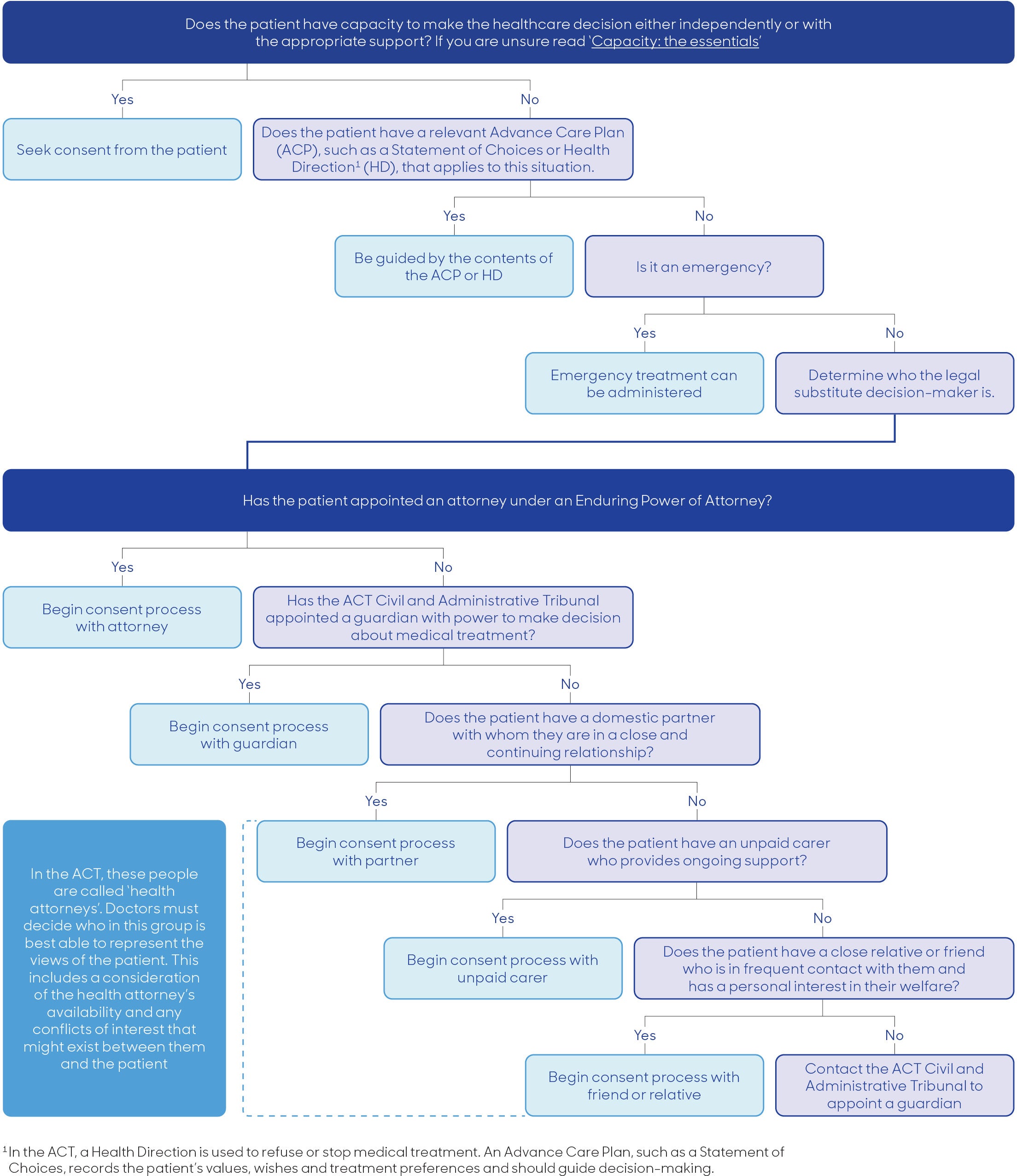
You should assess whether the patient requires urgent medical treatment. Where the patient is unable to give consent, treatment can generally be provided without consent if it is required to save life, prevent serious injury, or relieve significant pain or distress.
This applies where it is not possible or practicable to identify a substitute decision-maker or locate any relevant directive. Where known, any applicable Health Direction (HD) or Advance Care Plan (ACP) should be followed.
Advance Care Plan or Health Direction
In the ACT, a person may make a HD which is a legally binding refusal or withdrawal of medical treatment.
A person may also make an ACP, which records their preferences for future care.
If a valid and applicable HD or ACP exists, it must be followed. You will generally be protected under the legislation when acting in good faith in accordance with these documents.
Appointed decision-makers
A person with capacity may appoint an attorney to make healthcare decisions on their behalf through an Enduring Power of Attorney.
An attorney can generally consent to medical treatment (except for certain restricted matters) and may make decisions about life-sustaining treatment where this is consistent with good medical practice.
If there is both a HD and an Enduring Power of Attorney, and they are inconsistent, the most recently made document should be followed.
Informal decision-makers (health attorneys)
If there is no applicable directive and no appointed decision-maker, a decision may be made by a health attorney in accordance with the legislative hierarchy.
This is not automatically the patient’s next of kin. The appropriate person should be identified based on their relationship to the patient and their ability to represent the patient’s views.
Working with a health attorney
A health attorney should make decisions based on the patient’s known wishes and preferences, or, where these are not known, in the patient’s best interests.
When seeking consent, you should provide sufficient information to enable the decision-maker to make an informed decision.
If you have concerns that a decision-maker is not acting in accordance with these principles, you should seek advice.
Limits on decision-making
A health attorney can generally consent to most medical treatment.
However, they cannot consent to certain prescribed procedures, including:
- sterilisation or hysterectomy
- procedures relating to contraception
- removal of non-regenerative tissue for transplantation
- electroconvulsive therapy or psychiatric surgery
A health attorney does not have authority to refuse or withdraw treatment in the same way as a HD.
You are not required to provide treatment that is futile, not clinically appropriate, or not in the patient’s interests.
Additional resources
Avant factsheet: Capacity: the essentials
Australian Capital Territory: the Public Trustee and Guardian
For medico-legal advice, please contact us here, or call 1800 128 268, 24/7 in emergencies.
The information in this publication does not constitute legal, financial, medical or other professional advice and should not be relied upon as such. It is intended only to provide a summary and general overview on matters of interest and it is not intended to be comprehensive. Persons implementing any recommendations contained in this publication must exercise their own independent skill or judgement and seek appropriate professional advice relevant to their own particular circumstances. Compliance with any recommendations will not in any way guarantee discharge of the duty of care owed to patients and others coming into contact with the health professional or practice. Avant and its related entities are not responsible to any person for any loss suffered in connection with the use of this information. Information is only current at the date initially published.