

Substitute decision-makers for healthcare Northern Territory
Emergencies
You should assess if the patient requires urgent medical treatment.
Healthcare may be provided without consent where you reasonably believe that:
- the patient has impaired decision-making capacity in relation to the healthcare
- the healthcare is urgently necessary to:
- save the patient’s life
- prevent serious damage to the patient’s health, or
- prevent the patient suffering, or continuing to suffer, significant pain or distress
- it is not practicable to delay the healthcare to obtain, or attempt to obtain, consent from:
- the patient, if their impaired decision-making capacity is temporary, or
- a healthcare decision maker
- the healthcare is limited to what is necessary as a matter of urgency.
However, healthcare cannot be provided under this emergency provision if the healthcare provider is aware that the patient has refused that healthcare through:
- an advance consent decision contained in an Advance Personal Plan, or
- a previous informed refusal made while the patient had decision-making capacity.
Advance Personal Plans (APP)
An Advance Personal Plan (APP) is a formal record of a person’s preferences and decisions about future health care if they lose capacity.
An APP is only valid if it was made by an adult who had decision-making capacity at the time.
An APP may include:
- advance consent decisions, which provide consent to or refusal of specific future health care
- advance care statements, which outline a person’s values and preferences and can guide decision-making
- the appointment of a healthcare decision-maker to make decisions on the person’s behalf
If your patient does not have capacity, you should take reasonable steps to determine whether an APP exists and whether it applies to the decision being considered.
Any relevant advance consent decision must be followed if it is valid and applicable. Advance care statements should be used to guide decision-making.
Health care decision-maker
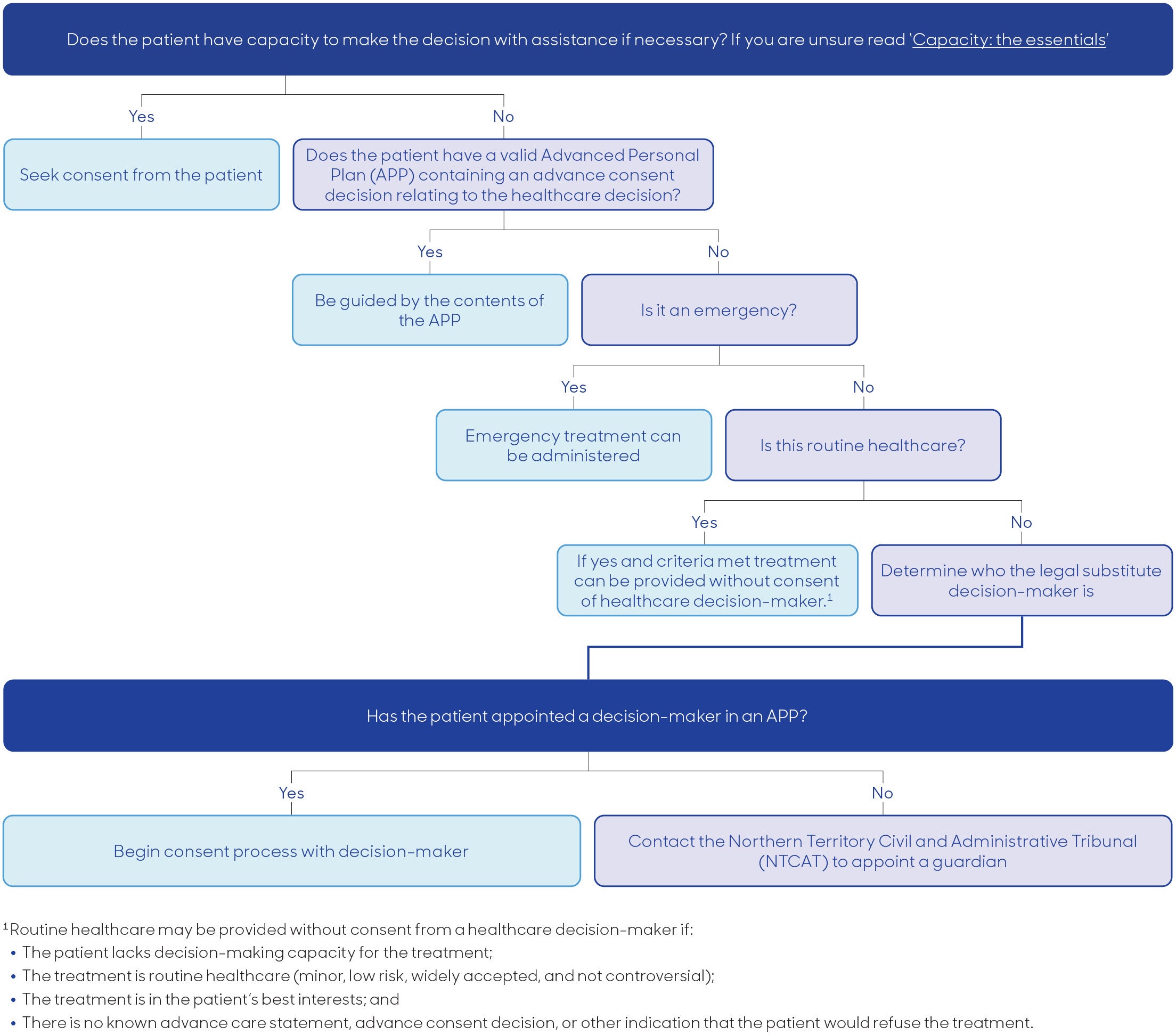
If a patient does not have capacity and there is no applicable Advance Personal Plan, you will need to identify the appropriate healthcare decision-maker.
As illustrated in the flowchart, this is not automatically the patient’s next of kin.
In the Northern Territory, a patient may have:
- appointed a health care decision-maker in an Advance Personal Plan
- had a guardian appointed by the Northern Territory Civil and Administrative Tribunal
Northern Territory law also recognises that Aboriginal or other customary law may inform who is the appropriate person to make health care decisions.
You should make reasonable efforts to identify and contact the appropriate decision-maker for the patient.
Routine healthcare
Routine healthcare may be provided without consent from a healthcare decision-maker if:
- the patient lacks capacity to make the decision
- the treatment is routine (minor, low risk, widely accepted and not controversial)
- the treatment is in the patient’s best interests
- there is no known Advance Personal Plan, advance consent decision, advance care statement, or other indication that the patient would refuse the treatment
Limits on decision-making
In the Northern Territory, a healthcare decision-maker can make decisions about commencing, continuing, withholding or withdrawing healthcare for a patient who has lost capacity.
However, they cannot consent to certain ‘restricted health care treatments’, including:
- sterilisation
- termination of pregnancy
- tissue donation
- electroconvulsive therapy
- experimental treatments
Consent for these treatments may need to be obtained from the Northern Territory Civil and Administrative Tribunal.
A decision-maker appointed in an Advance Personal Plan should act in accordance with any relevant decisions or statements in that plan.
A guardian may make decisions on behalf of the patient in accordance with the authority granted by the Tribunal.
Additional resources
For more information on
- assessing capacity, please see the Avant factsheet: Capacity: the essentials
- advance personal plans, including forms and guidelines, see the NT Government Advance Personal Plan page
- health care decision making in the Northern Territory, see the Office of the Public Guardian.
- advance care planning in all states and territories, see QUT End of Life Law for Clinicians or Advance Care Planning Australia.
For medico-legal advice, please contact us here, or call 1800 128 268, 24/7 in emergencies.
The information in this publication does not constitute legal, financial, medical or other professional advice and should not be relied upon as such. It is intended only to provide a summary and general overview on matters of interest and it is not intended to be comprehensive. Persons implementing any recommendations contained in this publication must exercise their own independent skill or judgement and seek appropriate professional advice relevant to their own particular circumstances. Compliance with any recommendations will not in any way guarantee discharge of the duty of care owed to patients and others coming into contact with the health professional or practice. Avant and its related entities are not responsible to any person for any loss suffered in connection with the use of this information. Information is only current at the date initially published.