

Substitute decision-makers for healthcare Tasmania
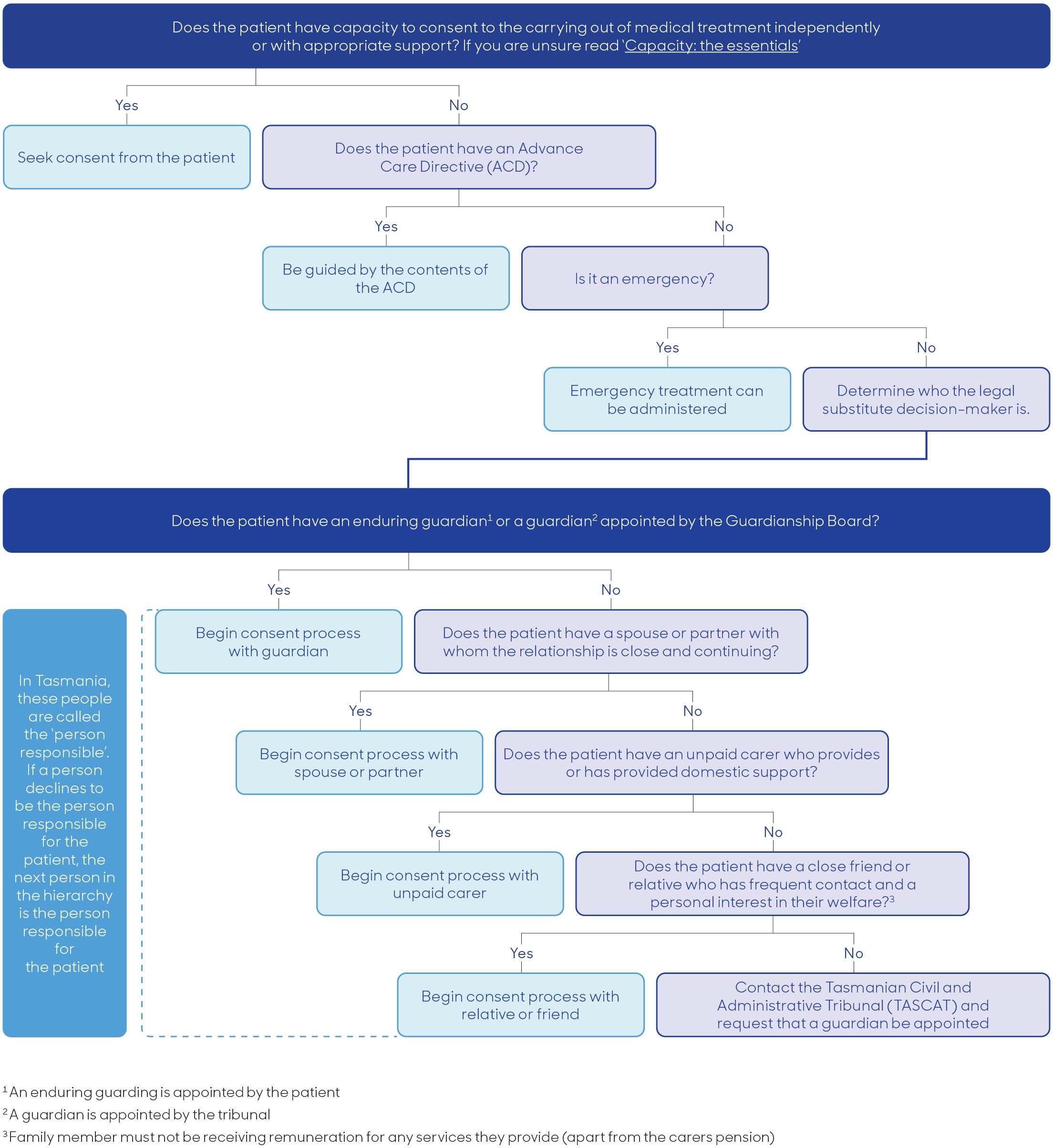
Emergencies
You should assess whether urgent treatment is required. Where the patient is unable to give consent, treatment may be provided without consent if it is necessary to save life, prevent serious harm to the patient’s health, or relieve significant pain or distress (other than in the case of special treatment).
Where known, any applicable Advance Care Directive (ACD) or previously expressed wishes of the patient should be taken into account.
Advance Care Directives
An ACD is a record of a person’s preferences for future health care if they lose capacity.
An ACD is only valid if it was made when the person had decision-making capacity and understood the nature and effect of the document.
If your patient does not have capacity, you should take reasonable steps to determine whether an ACD exists and whether it applies to the decision being considered.
An ACD may include refusals of specific treatments as well as statements of values and preferences to guide decision-making. These should be taken into account and followed where valid and applicable.
In Tasmania, an ACD does not need to be in a prescribed form, although a form is available to assist in preparing one.
Decision-makers
In Tasmania, if a patient does not have capacity, you will need to identify the appropriate person to make decisions on their behalf. This is not automatically the patient’s next of kin.
A person may appoint an enduring guardian to make decisions about their personal and health matters if they lose capacity. An enduring guardian is appointed by the patient and must act within the authority granted in the appointing document.
A guardian may also be appointed by the Guardianship and Administration Board to make decisions on behalf of a patient who lacks capacity.
If there is no appointed enduring guardian or tribunal-appointed guardian, consent may be provided by the person responsible. This is determined according to a statutory hierarchy. If a person declines to act as the person responsible, the next person in the hierarchy becomes the person responsible.
A person responsible may include a spouse or partner, an unpaid carer, or a close friend or relative. A person will generally not be considered if they are receiving remuneration for services they provide to the patient (other than a carer’s pension).
Tasmanian law also recognises Aboriginal and Torres Strait Islander kinship relationships when determining who is the appropriate decision-maker.
Limits on decision-making
In Tasmania, a decision-maker can consent to most medical treatment on behalf of a patient.
A person responsible can provide consent to treatment. However, the legislation does not give a person responsible (who is not a guardian) an express power to refuse treatment or withdraw consent. In practice, they may withhold consent, which may have the same effect as refusing treatment.
A decision-maker cannot consent to certain ‘special’ treatments, including sterilisation, termination of pregnancy and organ donation. Approval for these treatments must be obtained from the Guardianship and Administration Board.
The scope of a decision-maker’s authority may also be limited by the terms of their appointment. An enduring guardian or tribunal-appointed guardian must act within the powers granted in the appointing document or order.
Additional resources
For more information on
- assessing capacity, please see the Avant factsheet: Capacity: the essentials.
- advance care planning and directives in Tasmania, including forms and guidance, see Tasmanian Department of Health website
- advance care planning in all states and territories, see QUT End of Life Law for Clinicians or Advance Care Planning Australia.
For medico-legal advice, please contact us here, or call 1800 128 268, 24/7 in emergencies.
The information in this publication does not constitute legal, financial, medical or other professional advice and should not be relied upon as such. It is intended only to provide a summary and general overview on matters of interest and it is not intended to be comprehensive. Persons implementing any recommendations contained in this publication must exercise their own independent skill or judgement and seek appropriate professional advice relevant to their own particular circumstances. Compliance with any recommendations will not in any way guarantee discharge of the duty of care owed to patients and others coming into contact with the health professional or practice. Avant and its related entities are not responsible to any person for any loss suffered in connection with the use of this information. Information is only current at the date initially published.