
Birth of a business
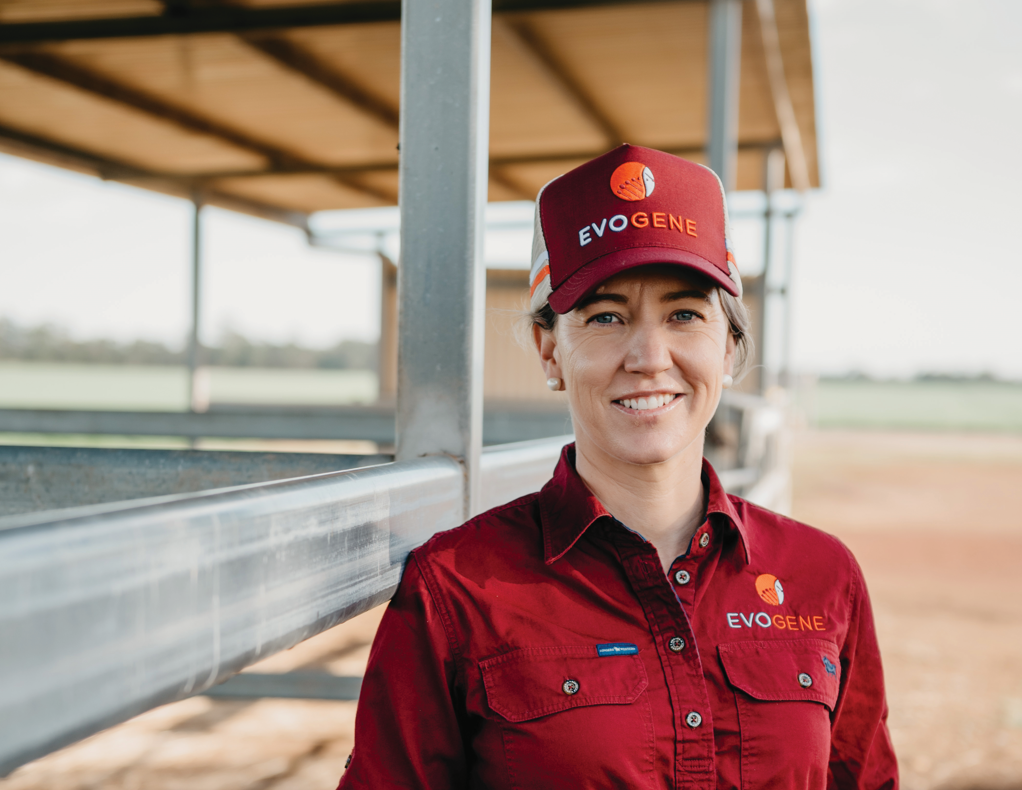
Dr Stacey Rae, Veterinarian
Photography provided by client
For Dr Stacey Rae, the turning point arrived not in a laboratory or a boardroom, but out in the wide, dry country of Central Queensland. After years of running a busy mixed practice and watching young veterinarians’ cycle through the same early-career challenges, she kept circling the same question: How do you keep skilled vets in the bush long enough for them to thrive? “It’s really about finding ways to support vets in rural practices,” Dr Rae says. “When they’re about five years out, they feel really competent, and they’re looking for the next challenge.”
The absence of those opportunities, and the quiet erosion of rural workforce capacity that followed, would eventually propel her into one of the boldest decisions of her career: launching Evogene, a reproductive genetics and IVF business designed specifically with regional veterinarians in mind. That instinct has deep roots. Growing up on a remote sheep and cattle station in far Western Queensland, she learnt early that distance was both a challenge and a teacher. “I was in the first cohort that went through James Cook University in Townsville when they very first opened up the vet school,” Dr Rae says. But she arrived there by an unconventional path, having spent several years jillarooing in the Kimberley to gain more industry experience before studying.
Graduating as a mature-age student in 2010, she moved straight into mixed practice, and straight into the reality of rural veterinary work. Large-animal reproduction had always been her passion. “Beef cattle and reproduction have always been my interest, and definitely equine reproduction as well,” she says. But in the bush, choice is a luxury. “You don’t really get to choose what you want to do. You have to do everything.”
The learning curve
Just a year after graduating, she made a decision many new vets wouldn’t contemplate: she bought a practice. Monto, a small town with a shuttered clinic and an ageing vet ready to step back, offered both opportunity and uncertainty. She approached him directly. “He took me on for the first six months on a see-how-you-go basis,” Dr Rae says. “And then it went quite well.” With backing from her husband Matt — “my offsider of all things veterinary nursing to practice manager,” as she describes him — she rebuilt the clinic almost from scratch. Over 14 years, Monto Veterinary Group grew from a single-vet operation to a two-clinic, six vet service that now anchors the region.
But success did not remove the pressures unique to rural practice. Recruiting veterinarians remained difficult. “They come for the job, and they come for the team, because they certainly don’t come for the little town,” she says. After-hours rosters were a chronic strain in the early years. “If you’re one of only one or two vets, you work all day, then get called out during the night. You can’t just cancel your appointments for the next day.” Partners of young vets also struggled to find professional roles in towns of barely 1200 people.
Meanwhile, the clinic’s workload rose and fell with livestock markets. “Our work fluctuates with season,” she says. “In good years, you get everything — emergencies and routine work — and when prices aren’t good, the value in the job just isn’t there.” These realities sharpened Dr Rae’s long-running interest in developing rural expertise for herself and others. She also saw a broader service gap emerging. “There’s a real gap in the market,” she says. “I wanted to offer more specialty to rural and regional areas.”
From little things…
The idea for Evogene crystallised when she reconnected with colleague Dr Amelia Rentz, who had worked in the Northern Territory before joining an IVF laboratory in Brisbane. Their backgrounds aligned, and so did their motivations. “We thought it was a way we could really move forward,” Dr Rae says. “And really support the veterinary profession by utilising Evogene to provide those services to regional areas.” Earlier this year, they purchased the IVF component of an existing business and set about re-imagining it as a rural-facing operation. The science was thrilling — but the logistics were daunting. “It’s a nightmare at times,” she admits.
Transporting time-sensitive genetic material from Central Queensland to the laboratory could take eight to 10 hours. Getting completed embryos back into live animals carried similar pressures. Courier services, road travel and even a local client with a plane, all became part of the weekly juggling act.
They soon expanded into equine IVF through the intracytoplasmic sperm injection (ICSI) process, becoming only the third business in Australia to offer the service. “The timelines are a little bit different,” Dr Rae says. “We’re certainly navigating the challenges between the cattle work and the horse work.”
Where Monto Veterinary Group had grown slowly and organically, Evogene required specialised equipment quick smart. Dr Rae’s first encounter with Avant Finance came almost by chance, while she was attending the national veterinary conference in Sydney in her role as Australian Cattle Vet president. “I said, ‘I’ve just purchased a lab. I’m interested in getting some finance for some new equipment’,” she recalls. “It was the easiest finance I’ve ever had to go through.”
The mobile laboratory — a caravan converted into a fully equipped reproductive suite—was the first major investment. More will follow. Having previously dealt with banks while expanding Monto Vet, the contrast was striking. “It was a very different experience,” she says. “They made it super easy.”
...big things grow
Now, months into ownership, Dr Rae and Dr Rentz are refining Evogene’s operating model and deepening partnerships with rural clinics across Australia. Their goal is not to centralise expertise, but to distribute it, training and supporting regional vets to expand their own capabilities while giving rural clients access to high-end reproductive services. For Monto Veterinary Group, the future is one of consolidation and careful growth. “The future is to solidify what we already have,” Dr Rae says. “Maybe expand to another vet or two, and continue to upskill vets into rural and regional areas.” Evogene, meanwhile, is the long game — a slow build of capability, logistics and national reach. “It’s a very new business,” she says. “It’s about working out how we can support vet clinics like Monto Vet, and other independent practices in rural Australia, to ensure we can offer those services in those areas.” In both ventures, the through-line is unmistakable: a belief that rural practice is worth investing in, and that innovation belongs just as much in the bush as anywhere else.
I think it’s something that some other lenders might look at as not being the core veterinary business of, say, owning their own practice. But we were able to support her in this new venture and provide a seamless experience with funding some of the startup costs. Other lenders who don’t specialise in these areas might not be willing to support something like this because it isn’t a standard veterinary practice startup.
"
The information in this article does not constitute tax or other professional advice and should not be relied upon as such. Persons implementing any recommendations contained in this article must exercise their own independent skill or judgment or seek appropriate professional advice relevant to their own particular circumstances.
The testimonials are from actual clients, reflecting their experiences with Avant Finance’s products and/or services. Testimonials are not necessarily representative of what anyone else using our products and/or services may experience. The testimonials are voluntarily provided and are not paid for or compensated unless explicitly stated. Avant Finance and its related entities are not responsible for any opinions expressed in the testimonials.