
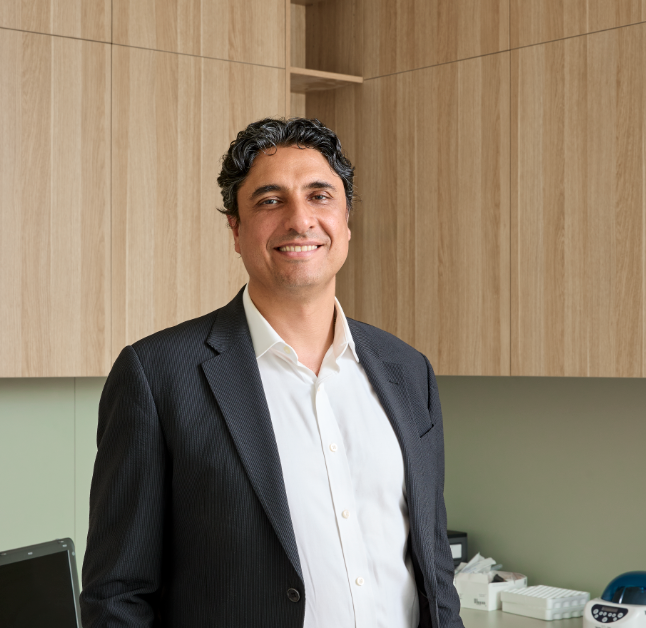
Practice reimagined
Associate Professor Homi Zargar
Photography by Fred Farquhar
When Associate Professor Homi Zargar set out to rebuild Western Urology, he wasn’t simply expanding a clinic. He was challenging the way private urology is usually delivered.
Associate Professor Zargar’s ambition was to bring advanced procedures, research capability and structured training into a single, community-based setting in Melbourne’s west. It was a model he had seen overseas, but rarely in Australia, and certainly not in private practice. For patients in the region, it would offer access to advanced care without travelling across the city — an unmet need he was determined to address. “Regardless of where people live, they deserve the best patient centred care and support to help them in making sound decisions most suitable to their values, needs and medical condition,” he explains.
The concept made sense clinically but, as the vision grew bolder, the operational and financial pressures grew sharper. Behind the innovation was a reality that most surgeons are not prepared for: building a modern medical practice requires business literacy that is not a focus of medical school. “Running a business is a completely different skill set,” Associate Professor Zargar says. “Nobody teaches us that in med school.”
Build it and they will come
That gap would shape the next phase of his career, testing not only his resilience but the sustainability of the model he was determined to bring to fruition.
A urological surgeon with fellowship training in uro-oncology and advanced laparoscopic and robotic surgery, Associate Professor Zargar owns Western Urology and lectures in the Department of Surgery at the University of Melbourne.
Originally from Iran, he completed his medical degree at the University of Otago, followed by surgical and urology training across New Zealand and further fellowships at three centres of global excellence: Vancouver Prostate Centre, Cleveland Clinic and Melbourne Uro-Oncology Training Program. The experience solidified his belief that innovation, evidence and accessibility should sit side by side. “In Vancouver, the way they approached research and surgical innovation was inspiring,” he says. “At Cleveland Clinic, the scale of work and pace of innovation were immense. You learned in months what might take years elsewhere.” After migrating to Victoria, Australia in 2015, he chose the west of Melbourne, one of the city’s fastest growing regions with historically limited specialist access. High-quality care was difficult to find locally, he reasoned, the solution was to build it.
Urology runs in the family. “It’s me, my dad and my brother —the three of us are urologists,” he says. “They were definitely an influence on my career. As a speciality, urology is wide ranging … and is at the forefront of technology.” Alongside his clinical work, Associate Professor Zargar spent four years as president of the Iranian Australian Association of Health Professionals, supporting community engagement, and continues as treasurer.
The three pillars
In 2019, after purchasing Western Urology from a retiring colleague, he began redesigning the practice around three pillars: patient care, clinical research and education. The centrepiece was a procedure room supported by endoscopy, electrocautery, sterilisation systems and diagnostic technology. The goal was simple: more streamlined, local access to care. “We can do many minor procedures in-house,” he says of the outcome. “It’s quite innovative, especially in private practice.”
Associate Professor Zargar added a clinical-trials unit investigating prostate, bladder and kidney cancers, including minimally invasive and robotic approaches and emerging diagnostic tools. It provides access to trials often limited to major hospitals.
“It is growing slowly but steadily,” he says of the research branch. “The more we share knowledge, the better patient care becomes.”
To support future clinicians, Associate Professor Zargar co-designed the surgical-education platform UrologyOR that provides structured, step-by-step operative teaching for trainees and early career surgeons. Training is online and in-person.
Finding clarity
But as capability expanded, so did the operational load. Administrative and regulatory pressures accumulated, particularly during COVID-19, as he navigated HR, payroll, leasing, compliance and financial structures while maintaining a full surgical workload. “Fitouts, council approvals, equipment costs; it’s overwhelming,” he says. “And financially, I was a bit unorganised. Every decision felt high stakes … you make calls about equipment, staffing, cash flow, and you’re never completely sure until it’s done. You learn everything on the fly. It is not what we are trained for.”
By 2020, multiple loans for the fitout, equipment purchases, the practice and personal borrowing were operating independently rather than supporting each other. Cash flow was unpredictable. Planning was difficult. “It was all becoming quite difficult,” he says. As an Avant member, he reached out for help. Associate Professor Zargar had known Kate Farley, Head of Residential Lending (Victoria and South Australia) at Avant Finance, from her banking days. Kate reviewed his structure and identified underlying issues: high repayments, misaligned loan structures and financial arrangements unintentionally constraining the practice.
“Kate helped us reorganise everything,” he says. “The best option was what she offered through Avant Finance.” Working across personal and practice lending, the Avant Finance team refinanced the fitout and equipment loans and restructured his home mortgage, easing pressure and simplifying repayments. The result was immediate relief. “Once we refinanced, it gave us a big breather,” he recalls. “The repayments changed, the structure changed. It made things a lot simpler.”
The clarity allowed him to focus again on growth and planning. External pressures slowed progress — one fitout stalled for months, others required multiple revisions — but the integrated model proved resilient, even during COVID-19.
“It immediately put the project to the test, and it came out very successfully,” he says. “We were still doing some of the procedures, when hospitals could not. It showed the model worked.” Support at home was equally important. His wife, dermatologist Dr Ritva Vyas, shaped her own practice using lessons learned from Western Urology. “She’s been there through it all,” he says. “After seeing how our first fitout went, she applied the same lessons when setting up her own practice. We learned together.”
Growth, learning and legacy
Today, Western Urology forms the foundation of The Urology Institute, a developing centre dedicated to multidisciplinary care, research and training across two sites and several consulting locations. A team of urologists, pelvic physiotherapists, allied-health clinicians and nurse practitioners grew around it. Two nurse practitioners trained in-house now practise independently. Seeing the next generation succeed is a strong motivator in his work. “I looked back at our 2019 group, and many are consultants now,” he says of his registrar training. The best part is seeing people you’ve trained become leaders themselves. That is when you realise the impact goes beyond your own practice.” Expansion into Melbourne’s east is now being explored. A business development manager will support the next phase.
"Medicine never stands still,” he says. “If we keep learning and adapting, we can keep improving patient care.” Reflecting on the last several years, the surgeon is clear about one lesson. “We become very good at managing medical and surgical issues, but nobody tells us how to run a practice, how to invest, how to grow. There’s limited support when you want to do something new.” Financial clarity, he says, changed everything. “When we refinanced through Avant Finance, it was not just about lower repayments, it was about clarity. They looked at the whole picture: practice, home, car, everything,” he says. “Once we refinanced, I had the headspace to plan again.”
For Associate Professor Zargar, success remains simple. “It’s not measured by how much billing you do or how many patients you saw,” he says. “Success is when a patient says, ‘You changed my life.’ The more of those stories, the more successful you are. You’re content with what you have but still looking for the next challenge. That is how we grow.”
The very restrictive banking structure Homi had originally was putting a lot of pressure on cash flow. Our role was to help him refine what he already had so he was in a better position moving forward. Once everything was reorganised, Homi had the financial freedom again to think about expansion. Twelve months earlier, that wouldn’t have been possible.
"
The information in this article does not constitute tax or other professional advice and should not be relied upon as such. Persons implementing any recommendations contained in this article must exercise their own independent skill or judgment or seek appropriate professional advice relevant to their own particular circumstances.
The testimonials are from actual clients, reflecting their experiences with Avant Finance’s products and/or services. Testimonials are not necessarily representative of what anyone else using our products and/or services may experience. The testimonials are voluntarily provided and are not paid for or compensated unless explicitly stated. Avant Finance and its related entities are not responsible for any opinions expressed in the testimonials.