

Consent-related claims
| Overview | Practice points |
|
|
All data is based on Avant claims and complaints closed from 1 July 2020 to 30 June 2025.
1 in 6 claims involved consent
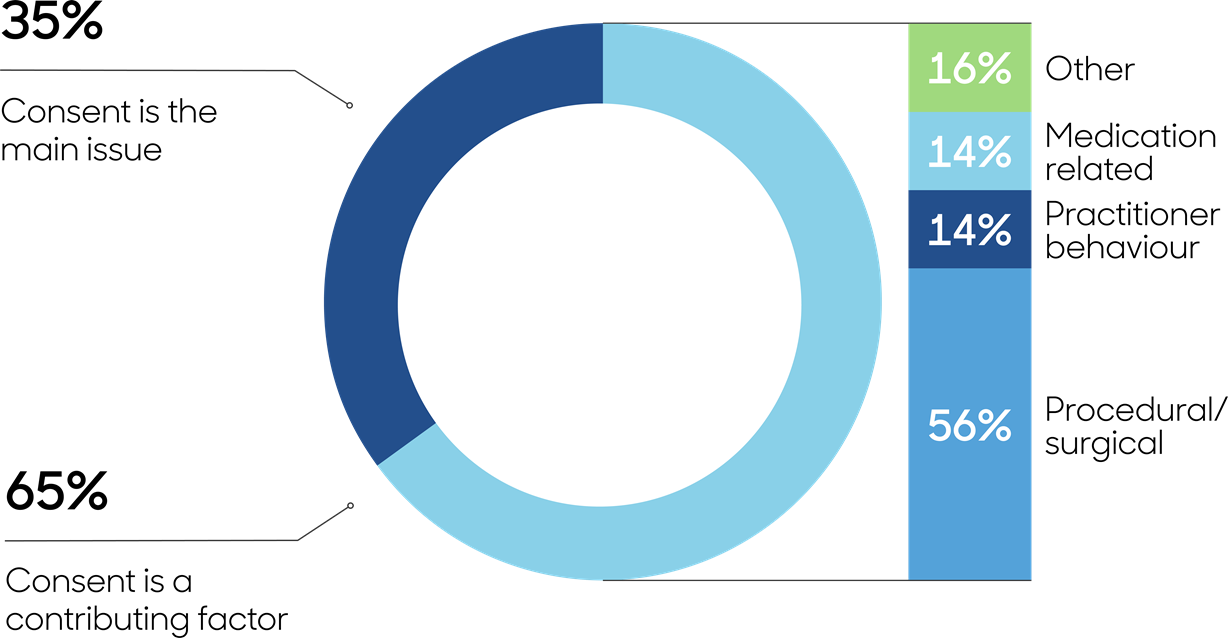
Consent was a concern across a wide range of claims including about a procedure or surgery, practitioner behaviour (e.g. tests, physical examinations) and medication.
In most cases, it was a contributing factor to the claim rather than the main cause.
| Procedural/surgical | Practitioner behaviour | Medication related | |
| Main issue often raised |
|
|
|
| Most common consent issue |
|
|
|
Across these claims, insufficient provision of information was the predominant issue.
- 91% of consent claims related to provision of information. Other issues involved capacity and documentation.
- The most common information gaps related to: the risks involved, explanation about the procedure, treatment or test, available options and clinical fees (e.g. no financial consent, incorrect quote, unhappy with fees charged).
- Not obtaining consent was another significant concern.

(% of issues related to provision of information. Each claim may have more than one consent allegation.)
Assessment of the care provided
Experts and/or regulators assessed the care provided in consent claims, with the following results:

(% of complaints/claims where the assessment of the expected standards on the main factor is known.)
About this analysis
This report is based on our analysis of the underlying themes in nearly 16,000 claims for Avant member doctors from all specialties, including complaints to regulators and compensation claims finalised between 1 July 2020 and 30 June 2025.
Claims involving consent were classified as those for which an issue with consent was the main or contributing factor.
More information
If you receive a claim or complaint, contact us on 1800 128 268 for medico-legal advice on how to respond- available 24/7 in emergencies.
Avant’s Risk Advisory Service provides personalised support to help proactively reduce your exposure to claims. You can benefit from a personalised risk assessment with a focus on strategy to improve your medical records. Contact us at Risk.Advisory@avant.org.au Risk.Advisory@avant.org.au or visit Risk Advisory Services - Avant.
Visit our Insights & Resources page for further educational content including webinars, eLearning courses, case studies, articles and factsheets.
IMPORTANT: Avant routinely codes information collected in the course of assisting member doctors in medico-legal matters into a standardised, deidentified dataset. This retrospective analysis was conducted using this dataset. The findings represent the experience of these doctors in the period of time specified, which may not reflect the experience of all doctors in Australia. This publication is not comprehensive and does not constitute legal or medical advice. You should seek legal or other professional advice before relying on any content, and practise proper clinical decision-making with regard to the individual circumstances. Persons implementing any recommendations contained in this publication must exercise their own independent skill or judgement or seek appropriate professional advice relevant to their own particular practice. Compliance with any recommendations will not in any way guarantee discharge of the duty of care owed to patients and others coming into contact with the health professional or practice. Avant is not responsible to you or anyone else for any loss suffered in connection with the use of this information. Information is only current at the date initially published. © Avant Mutual Group Limited 2026.